Why Did My Foot Suddenly Become Flat?
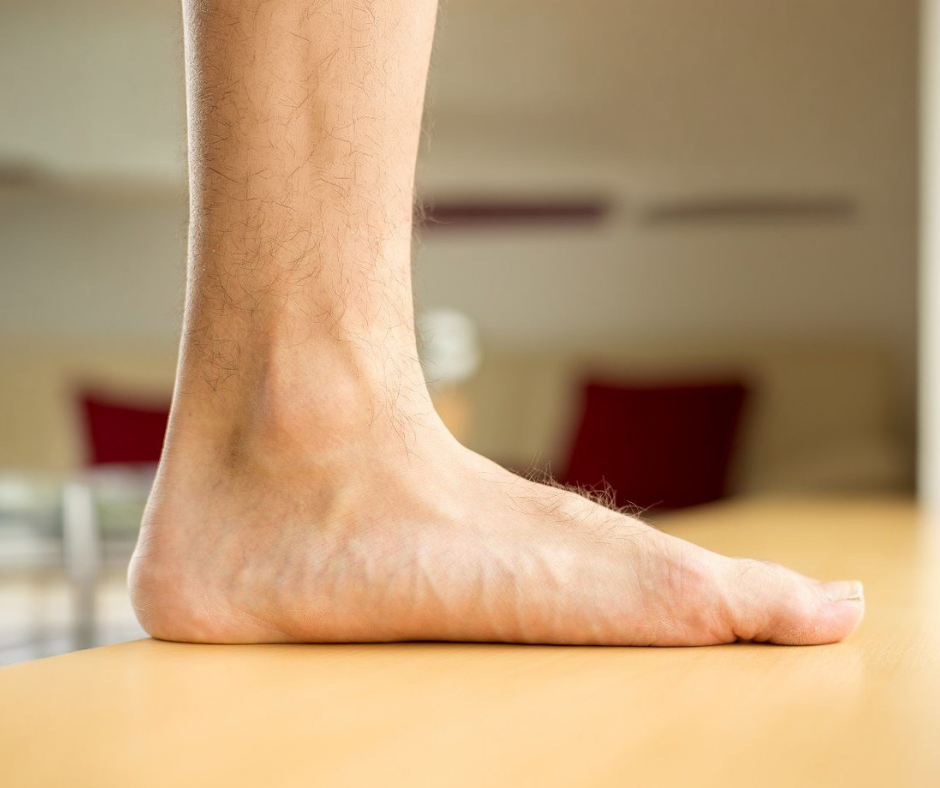
If you have spent your adult life with normal arches, looking down and noticing that one of your feet has suddenly flattened out against the floor can be alarming.
When an adult's arch collapses seemingly out of nowhere, it is rarely a temporary cramp or a minor strain. At The Foot & Ankle Center of Maryland, this specific structural shift is one of the most common reasons patients come to us looking for answers. Keep reading for the exact anatomical reason your foot is changing shape…and what you need to do to stop it.
The Culprit: Posterior Tibial Tendon Dysfunction (PTTD)
Your foot does not hold its arched shape by bone structure alone. It relies on a heavy suspension system.
· The most important piece of that system is the posterior tibial tendon, a thick cord that runs down the inside of your lower leg, behind your ankle bone, and attaches under the arch of your foot.
When this tendon becomes overworked, inflamed, or torn, it can’t hold the arch up.
· As the tendon stretches out and fails, the arch physically collapses. This condition is known as Adult Acquired Flatfoot, or Posterior Tibial Tendon Dysfunction (PTTD).
How to Spot the "Too Many Toes" Sign
If you are wondering if your arch has truly collapsed or if you just have localized swelling, you can perform a quick diagnostic check known as the "too many toes" sign.
· Stand barefoot and have a family member stand behind you, looking at your heels.
· Normally, only your pinky toe (and maybe the fourth toe) should be visible from directly behind.
· However, when the posterior tibial tendon fails, the entire foot collapses inward and rotates outward.
· From behind, your heel bone will look tilted, and three or four toes will be clearly visible on the outside of the foot.
If you see this structural shift, PTTD is likely the reason you're having trouble walking without pain.
The Danger of Ignoring a Collapsed Arch
Adult Acquired Flatfoot is a progressive deformity. It begins with a dull ache on the inside of the ankle but quickly escalates.
As the arch drops, it forces your joints completely out of alignment.
· This is why understanding the risks of poorly fitting shoes is only half the battle; if your skeletal structure is failing, no off-the-shelf shoe will fix the problem.
Eventually, the bones in the foot adapt to the flattened position and fuse in place, turning a flexible flat foot into a rigid deformity that could contribute to severe arthritis.
Biomechanical Scaffolding: Stopping the Collapse
Because PTTD alters your entire kinetic chain, standard rest and icing will not restore the tendon's tension. The only way to stop the progression is to physically lift the arch and relieve the mechanical strain on the tendon.
Clinical Gait Analysis: Before prescribing treatment, we need to see exactly how your foot strikes the ground. A comprehensive gait analysis is the missing link to determining how far your arch collapses during movement, not just when you are standing still.
Custom Orthotics: To stabilize the foot, you need a rigid, prescription scaffold. Over-the-counter gel pads cannot hold up a collapsing skeletal structure. You will quickly learn to appreciate your gait with custom orthotics once the device correctly redistributes your body weight away from the damaged tendon.
Sports Medicine Integration: If you are an active individual, we design our custom orthotics and sports medicine treatments to fit into your active lifestyle, ensuring you understand the relationship between orthotics, athletics, and you.
Rebuild Your Foundation
A collapsing arch will not fix itself. If you are experiencing pain on the inside of your ankle or noticing a visible change in the shape of your foot, early intervention is critical to avoiding complex reconstructive surgery.
Questions? Concerns? Contact the office of Dr. Ross Cohen of The Foot & Ankle Center of Maryland in Glen Burnie, MD, at (410) 761-3501 to schedule your initial diagnostic appointment.
We look forward to meeting you!